
The Hearing Loss Epidemic: Numbers That Should Alarm Everyone
Hearing loss isn't just an inconvenience—it's a national crisis affecting millions of Americans, with military veterans and industrial workers bearing the heaviest burden. The statistics reveal a problem far larger than most people realize.
The Scale of Hearing Loss in America
Civilian Population:
- Approximately 60.7 million Americans age 12 and older experience some form of hearing loss, according to the National Council on Aging
- 15.5% (44.1 million) of American adults age 20 and older have measurable hearing loss
- 31.1% of people age 65 and older experience hearing loss
- Approximately 28.8 million American adults could significantly benefit from wearing a hearing aid, according to the National Institute on Deafness and Other Communication Disorders (NIDCD)
- By 2050, an estimated 2.5 billion people worldwide will have some form of hearing loss, according to the World Health Organization
Workplace Impact:
- Approximately 12% of all U.S. workers face hearing challenges
- Occupational noise exposure remains a leading cause of preventable hearing loss
- Industries most affected: military, construction, manufacturing, music, and emergency services
Veterans and Military Personnel: Bearing the Highest Cost
The military population faces hearing loss rates that far exceed civilian statistics. The numbers tell a sobering story of the price service members pay for their service.
The Military Hearing Loss Statistics
Disability Rankings:
- Tinnitus is the #1 most claimed VA disability condition, according to the Hearing Health Foundation
- Hearing loss ranks #5 among service-connected disabilities
- Together, they represent the most prevalent bodily system injury after musculoskeletal disabilities
Affected Veterans:
- More than 1.5 million veterans receive disability compensation for hearing loss
- Over 3.2 million veterans receive compensation for tinnitus
- In 2020, more than 1.3 million veterans were receiving disability compensation for hearing loss and more than 2.3 million for tinnitus, according to the U.S. Department of Veterans Affairs
Prevalence Among All Service Eras:
- Hearing loss and tinnitus are the top two diagnoses among service members from Operations Enduring Freedom and Iraqi Freedom
- These conditions also affect veterans from the Vietnam Era, Korean Conflict, World War II, and peacetime service periods
The Rate of Tinnitus is Accelerating
Research from the South Texas VA Health Care System and the University of Texas at San Antonio examined health records of over 85,000 active duty service members and found that the rate of tinnitus more than tripled from 2001 to 2015.
Among those exposed to military noise, 80% may also suffer from chronic tinnitus, according to research published in Hearing Research—a permanent ringing, buzzing, or hissing in the ears that never goes away.
The True Cost: Billions Spent on Preventable Damage
Hearing loss isn't just a personal tragedy—it's an enormous financial burden on the healthcare system, the military, and society as a whole.
U.S. Department of Veterans Affairs Spending
Annual Costs:
- VA hearing health expenditures range from $1.5 billion to $2 billion annually in benefits and medical costs, according to a study published in the Journal of Military Medicine
- Annual VA disability payments for tinnitus and hearing loss exceeded $1.2 billion in 2009 and continue to increase
- Estimates approach $1.2 billion of entitlement for compensation and care of hearing loss and auditory system injuries in over 1.8 million Veterans in 2012 alone
The VA Healthcare System Impact:
- The VA is the largest employer of audiologists and speech-language pathologists in the United States
- Service-connected disability for hearing loss and tinnitus continues to rise annually
- The total amount spent on these disabilities increases every year
Global Economic Impact
- The socioeconomic impact of unaddressed hearing loss is estimated at approximately US$980 billion annually worldwide, according to the World Health Organization
- These costs include health sector expenses, educational support requirements, loss of productivity, and reduced quality of life
The 3M Combat Arms Earplugs Settlement
The scale of military hearing damage was highlighted by the largest mass tort multidistrict litigation in U.S. history. Over 300,000 veterans and service members filed claims against 3M for defective ear protection, resulting in a $6 billion settlement in 2023.
This settlement underscores a critical truth: inadequate hearing protection has catastrophic consequences, both for individuals and for the organizations responsible for protecting them.
Why Traditional Hearing Protection Falls Short
Standard hearing protection creates a dangerous trade-off: protection versus awareness. Traditional earplugs and earmuffs block harmful noise, but they also block critical sounds that tactical and industrial professionals need to hear.
The Situational Awareness Problem
In tactical environments, operators need to:
- Hear approaching threats from any direction
- Detect subtle environmental sounds
- Receive verbal commands and communication
- Maintain conversations without removing protection
- Identify the nature and location of hazards
Traditional hearing protection forces a choice: protect your hearing OR maintain situational awareness. This is an unacceptable compromise in environments where both are essential for survival.
The "Ear Muff Shuffle"
Anyone who has worked in noisy environments knows the routine:
- Remove hearing protection to hear a conversation
- Expose ears to harmful noise levels
- Replace protection and miss the next comment
- Repeat throughout the shift
This constant on-off behavior:
- Dramatically reduces effective protection
- Increases risk of impulse noise damage
- Creates frustration and reduced compliance
- Leads to workers abandoning protection entirely
Silynx Hearing Protection: Defense Without Compromise
Silynx Communications has engineered a solution that eliminates the protection-versus-awareness trade-off. Their tactical hearing protection systems provide military-grade protection while actually enhancing the user's ability to hear critical sounds.
How Silynx Hearing Protection Works
Passive Protection:
- Foam-sealed earbuds create a physical barrier to harmful noise
- NRR (Noise Reduction Rating) of 31 dB (34 SNR) on the Silynx CLARUS Pro X
- Proprietary Silynx Sound Leak Test confirms a proper ear seal for optimal protection
Active Protection:
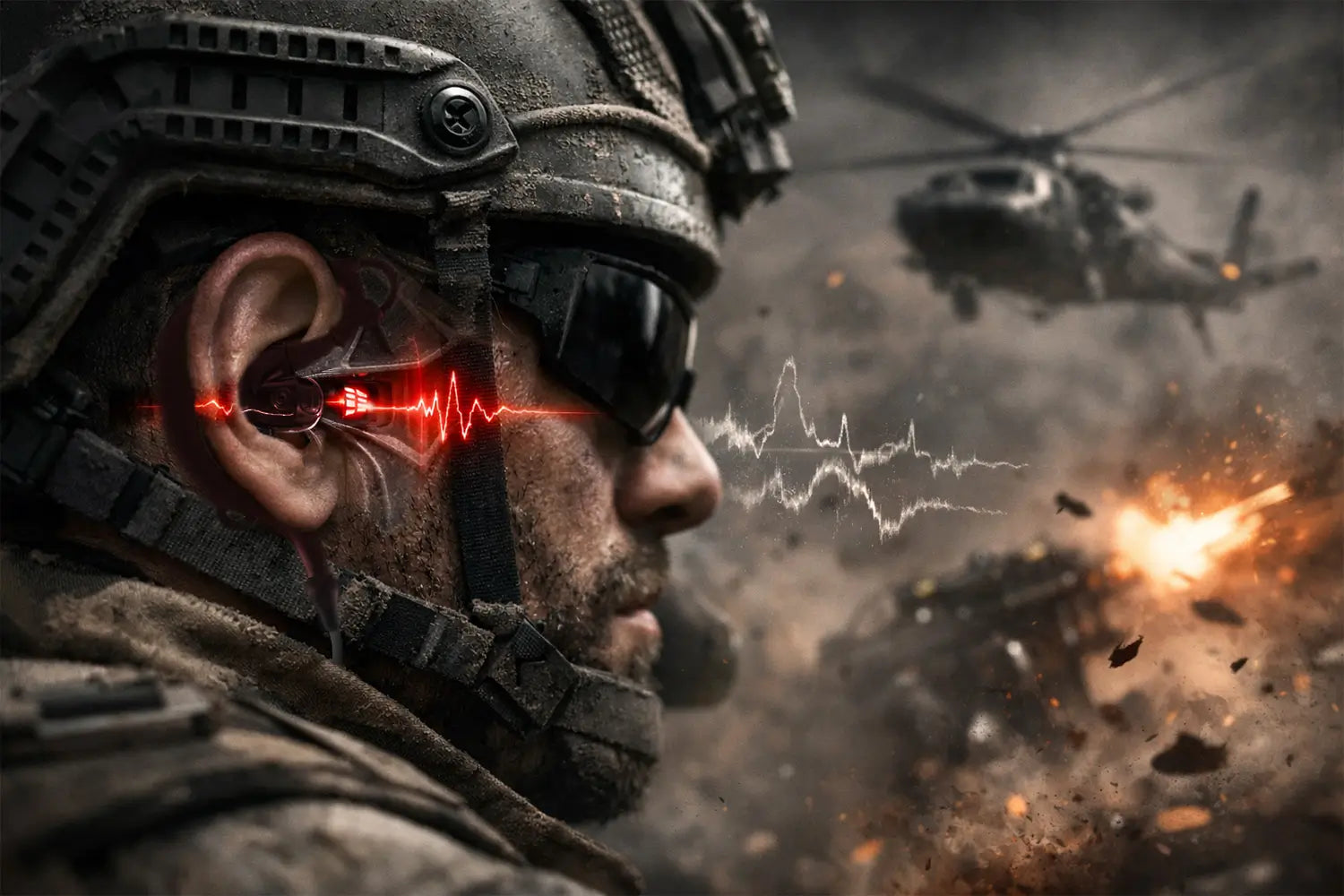
- During impulse noise events (gunfire, explosions), the hear-thru system responds instantly
- The system automatically and immediately compresses noise until decibels decrease to safe levels
- Protection activates faster than human reflex response
Hear-Thru™ Technology:
- Maintains 360° situational awareness while wearing protection
- Allows detection and identification of hazard sounds, nature, and location
- Enables verbal face-to-face conversations without removing protection
- Five adjustable HTL (Hear-Thru Level) sound enhancement levels
- Users control volume via buttons on the control unit
- Voice prompts indicate lowest and highest volume settings
The Key Differentiator: Enhanced Hearing
Unlike traditional protection that simply blocks sound, Silynx systems can actually enhance the user's natural hearing ability:
- Detect ambient noises that would otherwise go unheard
- Hear-thru volume adjustable in 3dB increments up to 15dB enhancement
- Maintain awareness even in quiet environments
- Full sound localization for directional threat identification
Silynx Products for Hearing Defense
Silynx CLARUS Pro X
Designed for elite infantry, special forces, and high-performance sports shooters who need hearing protection without communication capabilities:
Protection Features:
- Active hearing protection (NRR 31 / 34 SNR)
- 5-level Hear-Thru capability for situational awareness
- Impulse noise protection
- Enhanced hearing and sound localization
Durability Specifications:
- Environmental IP Rating: IP68 (submersible to 1m for 30 minutes)
- Operating Temperature: -40°C to +72°C
- Storage Temperature: -40°C to +72°C
- Tested to MIL-STD-810G
Battery Life: 72 hours on a single AAA battery—over 140 hours with a second AAA battery—with voice prompt low battery warning
Silynx CLARUS I and CLARUS II Systems
The combat-proven full tactical communication systems with integrated hearing protection - trusted by special operations forces worldwide.
Dual Functionality:
- Complete radio communication capability
- Active hearing protection
- 360° situational awareness
- Clear voice transmission
- Compatible with most tactical radios
Silynx Protego Pro In-Ear Headset
Next-generation in-ear tactical headset with dual-microphone architecture.
Protection + Awareness:
- Superior hearing protection using foam-sealed earbuds
- Environmental microphone continuously monitors external sounds
- Delivers external audio at safe, controlled levels
- True 360° situational awareness while maintaining full protection
The Science of Noise-Induced Hearing Loss
Understanding how hearing damage occurs helps explain why proper protection is so critical.
How Loud is Too Loud?
| Sound Level (dB) | Example | Safe Exposure Time |
|---|---|---|
| 85 dB | Heavy city traffic | 8 hours |
| 90 dB | Power tools | 2 hours |
| 100 dB | Motorcycle | 15 minutes |
| 110 dB | Rock concert | 2 minutes |
| 120 dB | Thunderclap | Immediate damage |
| 140+ dB | Gunfire | Instant permanent damage |
How NRR (Noise Reduction Rating) Works
The NRR rating indicates potential noise reduction in decibels. However, the actual protection is calculated using the OSHA formula (29 CFR 1910.95 Appendix B):
Actual Reduction = (NRR - 7) ÷ 2
For the Silynx CLARUS Pro X with NRR 31:
- (31 - 7) ÷ 2 = 12 dB actual reduction
While this may seem modest, remember that decibels are logarithmic:
- 10 dB reduction = cutting perceived loudness in half
- Combined with active compression for impulse noise, protection is significantly enhanced
Impulse Noise: The Silent Killer
Gunfire and explosions create impulse noise—sudden, intense sound pressure that can cause immediate, permanent damage. Unlike steady-state noise (machinery, traffic), impulse noise:
- Occurs faster than human reflex response
- Can damage hearing in a single exposure
- Is the primary cause of military hearing loss
- Cannot be effectively blocked by passive protection alone
Silynx systems respond to impulse noise automatically and immediately, compressing the sound faster than any human could react.
Protecting Your Hearing: Best Practices
For Military and Tactical Personnel
- Wear protection consistently - Don't remove hearing protection during training or operations
- Use electronic protection - Passive-only protection forces dangerous trade-offs
- Maintain situational awareness - Choose systems with hear-thru technology
- Test fit regularly - Proper seal is essential for protection
- Document exposure - Track noise exposure for VA claims
For Industrial Workers
- Know your environment - Identify noise sources above 85 dB
- Use appropriate NRR - Match protection to hazard level
- Maintain communication - Choose systems that allow conversation
- Don't compromise - Never remove protection "just for a moment"
- Follow OSHA guidelines - Comply with workplace hearing conservation requirements
For Shooting Enthusiasts and Hunters
- Protect every shot - A single gunshot can cause permanent damage
- Hear your surroundings - Use hear-thru technology for safety and hunting effectiveness
- Connect your devices - Modern systems allow phone and music connectivity
- Invest in quality - Your hearing is irreplaceable
Frequently Asked Questions About Hearing Protection
What NRR rating do I need?
For most tactical and industrial environments, NRR 31 (like the Silynx CLARUS Pro X) provides excellent protection. The key is consistent use—the best protection in the world doesn't work if it's uncomfortable and gets removed.
Can I still hear commands and conversation with hearing protection?
With traditional earplugs or earmuffs, hearing is significantly impaired. With Silynx Hear-Thru technology, you can hear conversations clearly, detect environmental sounds, and maintain 360° situational awareness while protected.
How does Silynx protect against gunfire?
Silynx systems use active compression that automatically responds to impulse noise events. When the system detects a sudden decibel spike (like gunfire), it instantly compresses the sound to safe levels—faster than human reaction time.
Is hearing damage reversible?
No. Noise-induced hearing loss is permanent. The hair cells in the inner ear that detect sound do not regenerate. Once damaged, hearing loss and tinnitus are lifelong conditions. Prevention is the only effective strategy.
Why is tinnitus so common among veterans?
Military service involves repeated exposure to high-decibel environments: weapons fire, explosions, aircraft, armored vehicles, and heavy machinery. Of those exposed to military noise, 80% may also develop chronic tinnitus, according to research published in Hearing Research.
The Bottom Line: Hearing Protection is an Investment, Not an Expense
The statistics are clear:
- Millions of Americans suffer from preventable hearing loss
- Veterans bear a disproportionate burden, with billions in annual treatment costs
- Traditional hearing protection forces unacceptable trade-offs
- Modern technology like Silynx Hear-Thru eliminates these compromises
Your hearing is irreplaceable. Once damaged, it cannot be restored. The ringing of tinnitus never stops. The struggle to hear conversations, enjoy music, or detect warning sounds becomes a daily reality.
Silynx Communications has developed hearing protection technology that provides military-grade defense while actually enhancing situational awareness. For military operators, law enforcement officers, industrial workers, and shooting enthusiasts, this represents the new standard in hearing defense.
Don't become a statistic. Invest in hearing protection that works—protection that you'll actually wear because it doesn't compromise your ability to do your job.
Explore Silynx hearing protection systems for military, law enforcement, and industrial applications, or see the CLARUS Pro X for standalone hearing protection.